Food Grade Boiler Condensate Treatment Chemical
Condensate systems have problems caused by iron and copper corrosion neutralizing amines are used to neutralize the acid (H+) generated in the condensate. They control corrosion in the condensate system by maintaining a protective coating of iron oxide over the metal surfaces while supplying sufficient material of an alkaline nature to neutralize the carboni
Food Grade Boiler Condensate Treatment Chemical
Condensate systems have problems caused by iron and copper corrosion neutralizing amines are used to neutralize the acid (H+) generated in the condensate. They control corrosion in the condensate system by maintaining a protective coating of iron oxide over the metal surfaces while supplying sufficient material of an alkaline nature to neutralize the carbonic acid that is formed in the condensate system. Our formulation is a blend of volatile product for steam condensate treatment that provides the direct neutralization of carbon dioxide and ensures positive corrosion protection. It is formulated to provide an ideal vapour-liquid distribution ratio to protect all parts of the steam/condensate system with the minimal product loss.
Where the product fits in a treatment programme.
Final selection and dosage should be based on current water analysis, system operating data, compatibility and product literature.
Typical applications
- Industrial steam boilers
- Food and beverage plants where appropriate certification is required
- Pharmaceutical and process steam utilities
- Textile, dairy, chemical and manufacturing facilities
- Boiler feedwater and condensate-return systems
- Long condensate-return networks
Advantages and treatment objectives
- Food Grade Boiler Water Treatment
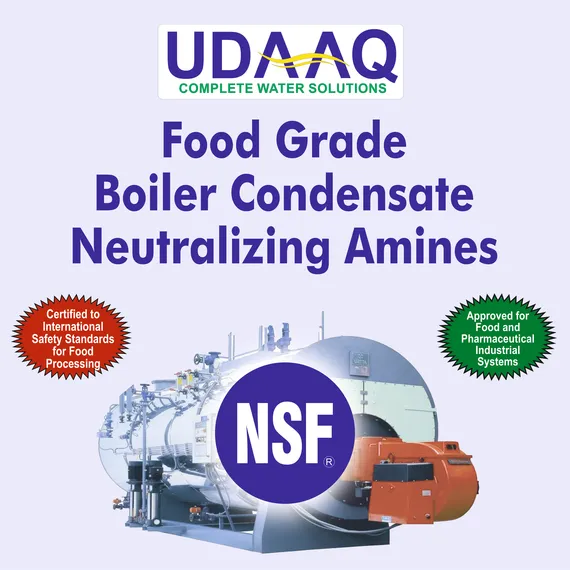
- NSF Certified for Food Processing Boiler Treatment
- Environment-friendly and Non-Toxic Boiler Treatment
- Economical and Ready to use in 35/50 KG Pack
- High Temperatures and High-Pressure Stability
- Easy to handle with Rapid Action for Instant solution
- Complete Boiler Protection to enhance system life
- Supports cleaner heat-transfer surfaces
- Helps reduce scale- and corrosion-related downtime
- Supports stable boiler-water chemistry
- Can simplify routine dosing and control
- Helps improve reliability when used with proper blowdown and monitoring
- Neutralisation of carbonic-acid attack in condensate lines
Parameters to monitor
- Boiler-water pH and alkalinity
- Feedwater hardness and dissolved oxygen
- Phosphate/sulphite residual where applicable
- TDS or conductivity and blowdown rate
- Condensate pH, iron and copper
- Steam production, fuel consumption and tube cleanliness
- Condensate pH and return-line iron
Specification and product documents.
Published specification
- Form: Liquid
- Packing: 35KG / 50KG HEDP Polycan
- HSN: 38249022
- Refer to Product Literature for Complete Product Specification
Product literature
Safe implementation
Review the current TDS and SDS before storage, handling, dilution or dosing. Confirm material compatibility, PPE, dosing point and treatment residuals with the site water-treatment specialist.
Common implementation questions.
How is the correct dosage selected?
Dosage depends on system volume or flow, water analysis, operating pressure or recovery, contaminant loading and the target residual. Start from the current product literature and optimise using measured results.
Can this product be selected only from the product name?
No. Similar problems can have different causes. Confirm the system type, water chemistry, metallurgy, operating conditions and existing treatment before changing the programme.
What should be monitored after starting treatment?
Monitor the application-specific parameters listed above, together with dosage, residual, system performance and equipment condition. Trend data is more useful than a single isolated reading.
Where can I obtain the latest TDS, MSDS or certificate?
Use the document links on this page where available, or contact Rakiro for the latest controlled copy.