
Food Grade Cooling Tower Bio Dispersant
The accumulation of microbiological slimes biofilm and general bio-fouling in cooling water systems reduces system efficiency increases operating and maintenance costs and raises risks to safety and health. Our polymeric dispersent is a synthetic organic anti-foulant which inhibits the deposition of fouling materials on the heat transfer surfaces. It elimina
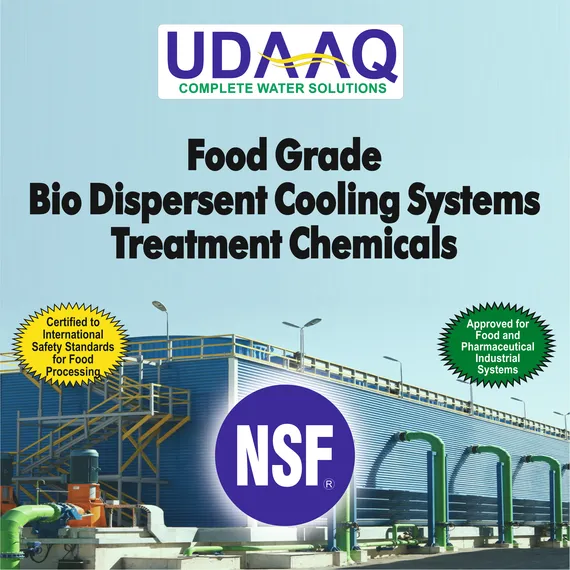
Food Grade Cooling Tower Bio Dispersant
The accumulation of microbiological slimes biofilm and general bio-fouling in cooling water systems reduces system efficiency increases operating and maintenance costs and raises risks to safety and health. Our polymeric dispersent is a synthetic organic anti-foulant which inhibits the deposition of fouling materials on the heat transfer surfaces. It eliminates fouling caused by dead microbiological growth phosphates silicates metallic oxides silt and other air-borne materials. Thus it keeps surfaces clean maintains a high rate of heat transfer and aids the formation of corrosion inhibitor film.
Where the product fits in a treatment programme.
Final selection and dosage should be based on current water analysis, system operating data, compatibility and product literature.
Typical applications
- Open recirculating cooling towers
- Closed chilled-water and process-cooling loops
- Evaporative condensers and air washers
- Heat exchangers and condenser-water circuits
- Food, pharmaceutical, HVAC and industrial utilities
Advantages and treatment objectives
- Food Grade Cooling Water Treatment
- NSF Certified for Food Processing Cooling Treatment
- Environment-friendly and Non-Toxic Cooling Treatment
- Economical and Ready to use in 35/50 KG Pack
- High Tolorence and Chemical Stability
- Easy to handle with Rapid Action for Instant solution
- Complete Cooling Tower Protection to Enhance system life
- Supports efficient heat transfer
- Helps control scale and corrosion
- Reduces fouling and deposit accumulation
- Supports cleaner tower fills and piping
- Can reduce cleaning frequency when properly controlled
- Helps detach and disperse biofilm and dead microbial mass
Parameters to monitor
- Make-up and circulating-water hardness
- pH, conductivity and cycles of concentration
- Corrosion coupons or probes
- Microbiological counts and biofilm condition
- Approach temperature and heat-exchanger pressure drop
- Biocide residual and blowdown performance
Specification and product documents.
Published specification
- Form: Liquid
- Packing: 35KG / 50KG HDPE Polycan
- HSN: 38249022
- Refer to Product Literature for Complete Product Specification
Product literature
Safe implementation
Review the current TDS and SDS before storage, handling, dilution or dosing. Confirm material compatibility, PPE, dosing point and treatment residuals with the site water-treatment specialist.
Common implementation questions.
How is the correct dosage selected?
Dosage depends on system volume or flow, water analysis, operating pressure or recovery, contaminant loading and the target residual. Start from the current product literature and optimise using measured results.
Can this product be selected only from the product name?
No. Similar problems can have different causes. Confirm the system type, water chemistry, metallurgy, operating conditions and existing treatment before changing the programme.
What should be monitored after starting treatment?
Monitor the application-specific parameters listed above, together with dosage, residual, system performance and equipment condition. Trend data is more useful than a single isolated reading.
Where can I obtain the latest TDS, MSDS or certificate?
Use the document links on this page where available, or contact Rakiro for the latest controlled copy.